
Share
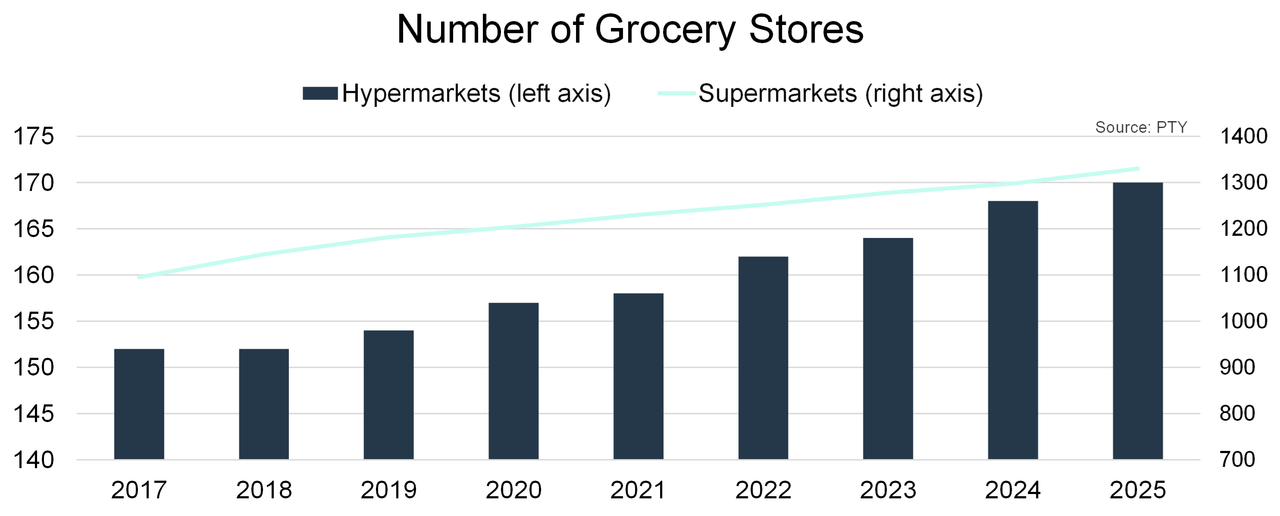
The total number of grocery stores has declined year after year, while the number of supermarkets and hypermarkets continues to grow. This trend is partly driven by sales and sales growth increasingly concentrating in larger stores.According to Kesko, all major operators continue to make significant investments in hypermarkets, supermarkets and smaller grocery stores, reflecting confidence in the sector’s long-term outlook.
Finland’s long distances and low population density highlight the importance of efficient logistics in the grocery retail sector. Large volumes of goods need to be transported in each delivery to keep costs at a reasonable level. This favours large retail chains, which can centralise procurement and distribution. With a combined market share of more than 80%, S Group and K Group enjoy a considerable cost advantage over potential new market entrants.
S Group and Kesko have strengthened their market positions by investing in efficient logistics and large-format stores. Scale and centralised distribution support competitive pricing. At the same time, increased consumer price sensitivity, weak economic conditions and promotional campaigns have increasingly shifted demand towards larger stores. The number of grocery stores continues to decline, particularly smaller ones. In 1978, Finland had 9,398 grocery stores, compared with just 2,619 in 2025. Nevertheless, smaller stores play an important role in ensuring access to local services and maintaining the attractiveness of residential areas.
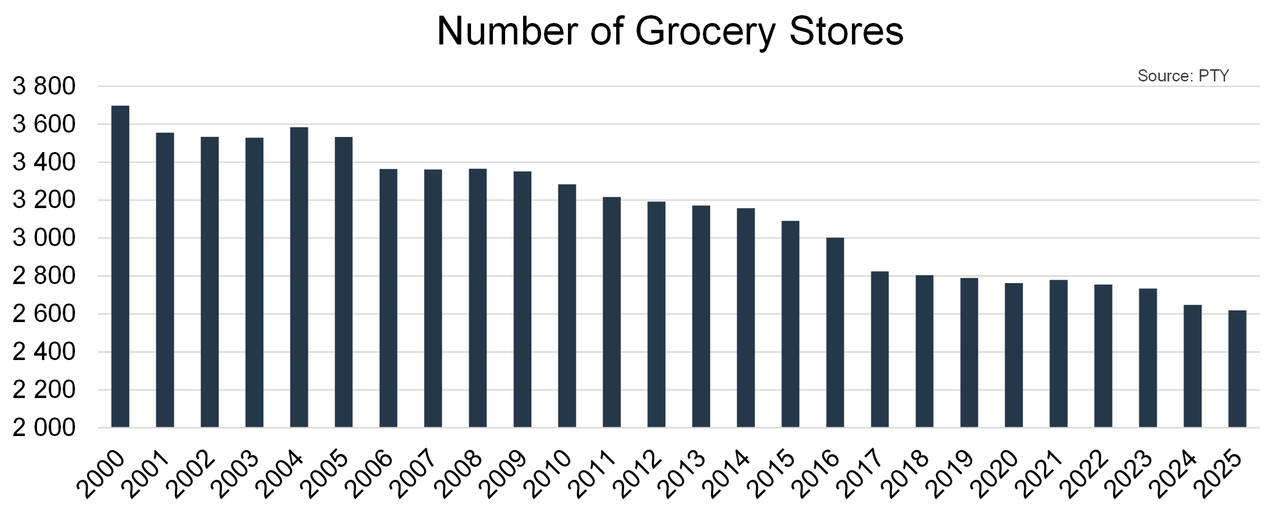
“Growth in the grocery retail sector has been driven particularly by supermarkets and hypermarkets, which together account for more than 80% of the market. Hypermarkets have performed best among store formats, and large stores play a key role in ensuring food supply in urban areas. Although the total number of grocery stores has declined, particularly among smaller outlets, the supermarket and hypermarket networks continue to expand. According to Kesko, all major operators will continue to make significant investments across hypermarket, supermarket and smaller store formats, reflecting confidence in the sector’s long-term outlook. However, sales performance varies considerably between store formats,” summarises INNA’s real estate analyst Anton Takkavuori.
Big Stores Lead the Way, Smaller Stores Face Headwinds
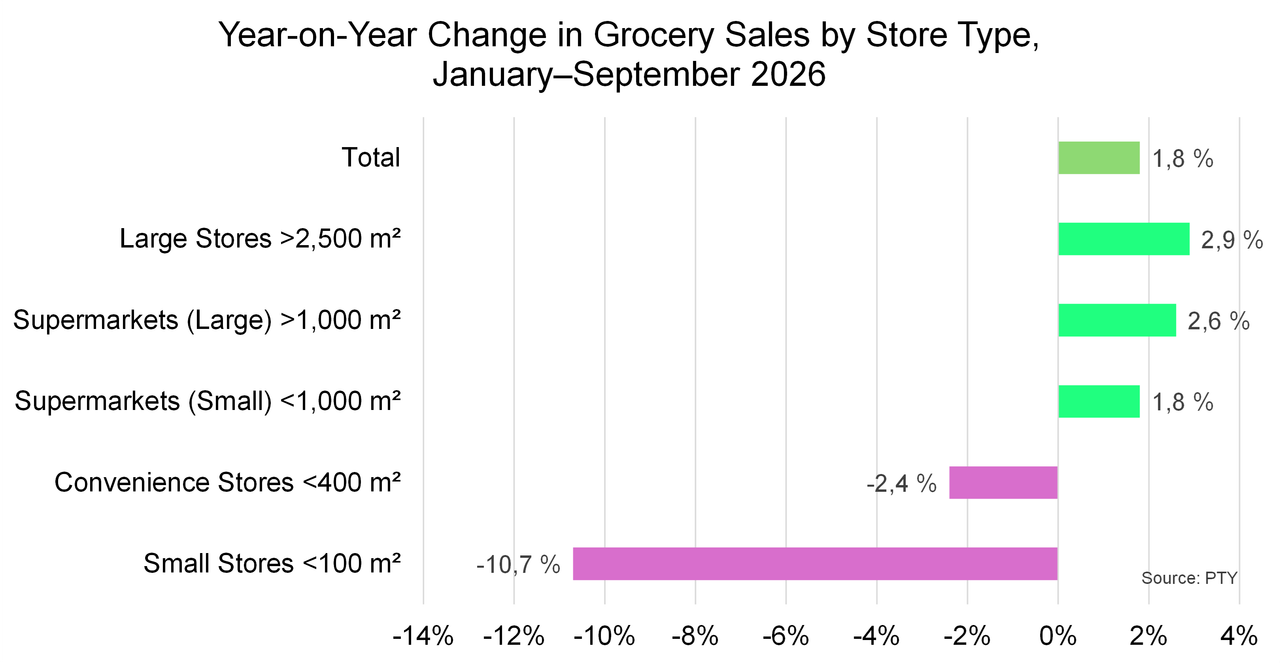
The past year has been dominated by large stores in the grocery retail sector. Among the member companies of the Finnish Grocery Trade Association (PTY), sales at large stores increased by 2.9% in January–September, compared with 2.6% at large supermarkets and 1.8% at small supermarkets. Meanwhile, sales at convenience stores declined by 2.4% and at small grocery stores by 10.7%. PTY’s member companies account for approximately 96% of Finland’s grocery retail market, providing a comprehensive picture of developments across the sector. The sales figures further underline the strength of large-store formats in grocery retail.
The same trend is also reflected in the market shares and store networks of grocery retail chains. According to Kaupan Tila, the market shares of both K-Market and S Group’s Alepa and Sale chains have declined over the past ten years. Their store networks have also contracted, despite average sales per store increasing.
However, the shift in growth towards hypermarkets and large supermarkets does not mean that the market is moving exclusively towards ever-larger stores. Kaupan Tila points out that the true crown jewel of Finland’s grocery retail sector is the S-Market chain.
Keeping the Foot on the Gas: New Hypermarkets in the Pipeline
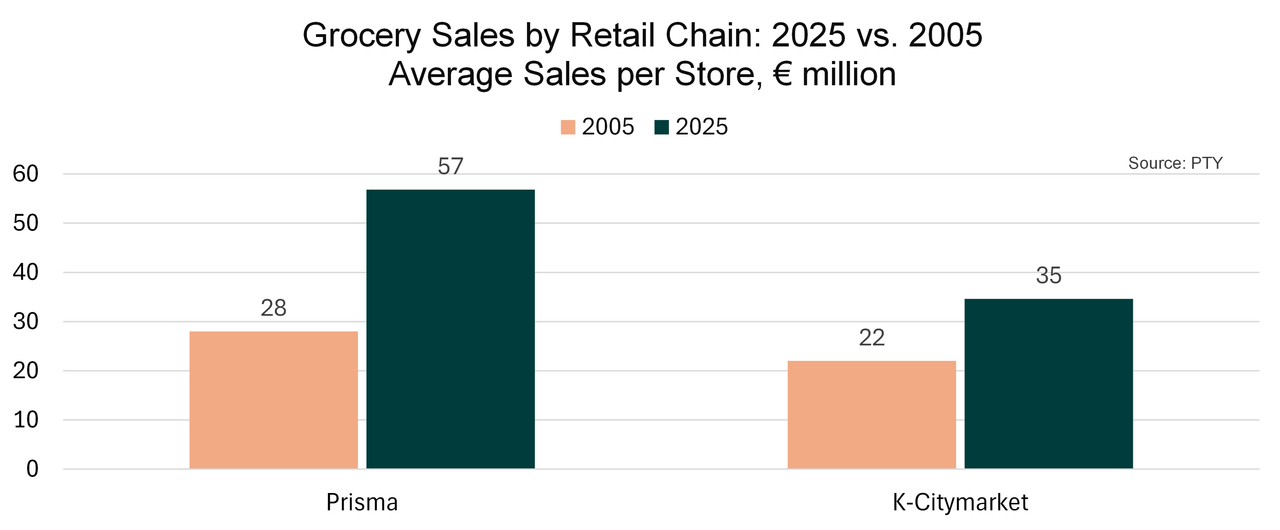
Prisma has strengthened its position as Finland’s leading hypermarket chain. Its lead over K-Citymarket has widened considerably since the early 2000s, as Prisma has grown its sales at a faster pace than its competitor. This development is reflected in average sales per store: in 2005, the average Prisma store generated approximately €6 million more in sales than a K-Citymarket. Two decades later, the gap had widened to approximately €22 million per store.
Despite Prisma’s strong position, competition in the hypermarket market remains fierce. In 2026, Prisma opened new stores in Karvetti, Naantali, and Hyrylä, Tuusula. K Group is also strengthening its position in the large-format grocery retail segment. In 2026, new K-Citymarket stores opened in Kivistö, Vantaa, Haapaniemi, Kuopio, and Ylivieska. Further K-Citymarket projects, either new stores or replacements for existing ones, are planned for Jokiranta in Porvoo, Ritaportti in Oulu, Redi in Helsinki and Espoontori in Espoo. In addition, a new hypermarket is planned for Tikkurila, Vantaa.
The extensive development pipeline demonstrates that both retail groups continue to see growth opportunities in the hypermarket segment. Although Prisma leads the hypermarket market, S-Market remains the largest grocery retail chain overall.
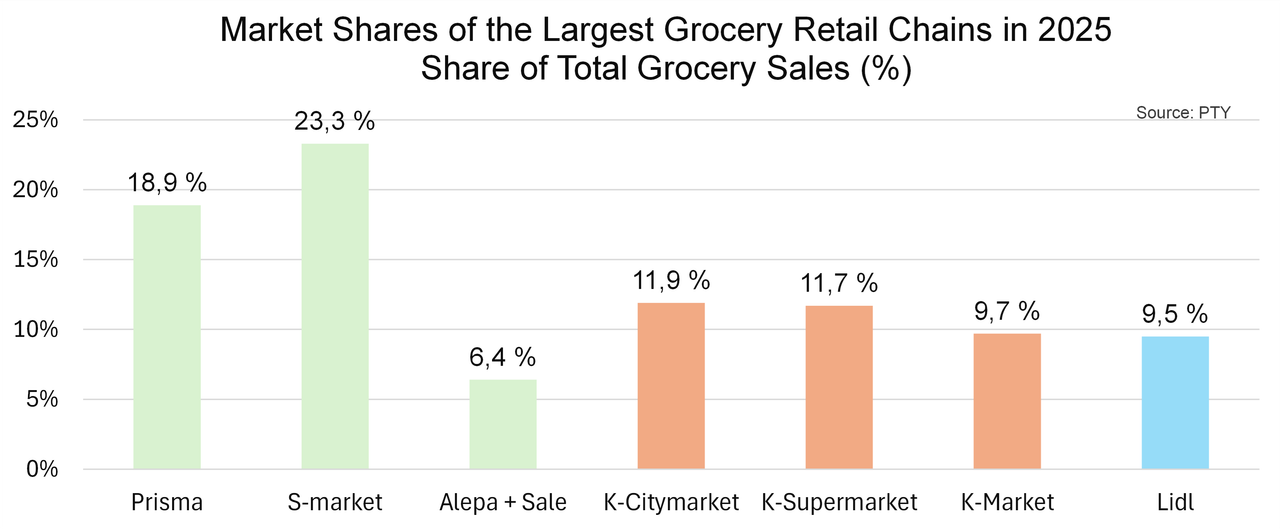
In 2025, S-Market held a market share of 23.3%, 4.4 percentage points higher than Prisma’s. It was also the only grocery retail chain to exceed a 20% market share. This strong position is primarily built on its extensive store network. This demonstrates that success in grocery retail is not driven by hypermarkets alone, as strong concepts can be found across different store formats.
From an investor’s perspective, store size is only one factor determining the success of a grocery retail property. Equally important are the suitability of the store concept for the area, local demand and the competitive landscape in the surrounding area. According to Kaupan Tila, for example, large K-food stores achieving an operating profit margin of more than 4% shared one common characteristic: they had no direct competitors in their immediate vicinity. Although large retail chains dominate grocery retail at the national level, the success of individual stores is ultimately determined by local market conditions.

Anton Takkavuori
Sources: Finnish Grocery Trade Association (PTY), Kaupan Tila and Kesko