

Share
For Q2, market commentary on the HMA’s non-subsidised rental market was notably more optimistic. In its H1 report, Lumo said that rental activity had been very brisk in Q2 and that there were signs of improving conditions in the HMA’s rental market. According to Lumo, the supply of rental apartments has started to decline, which has also been reflected in improving occupancy rates. SATO likewise reported that the number of vacant apartments in the HMA had begun to decline gradually. However, supply remains high.
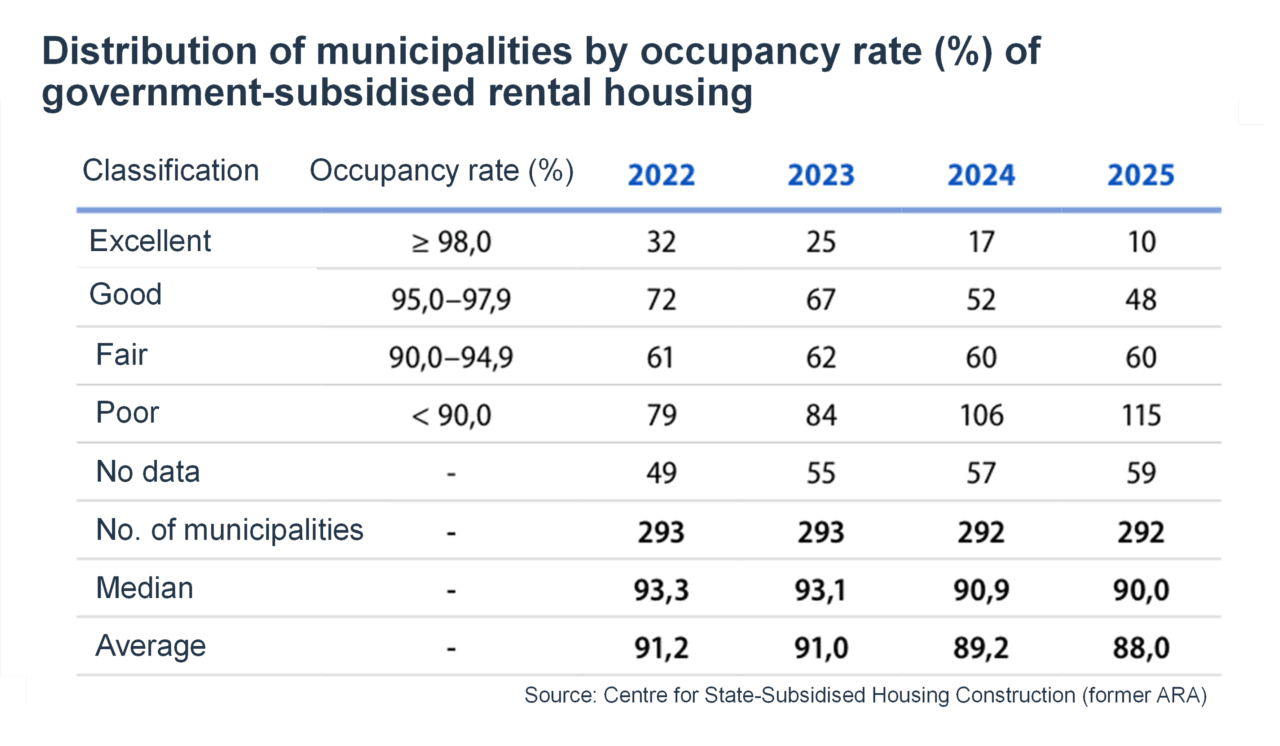
The large supply of non-subsidised rental apartments is increasingly affecting demand for government-subsidised rental housing. Applicant numbers for government-subsidised rental housing have fallen, while vacancies have reached record levels and occupancy rates have weakened. In early 2026, the number of applications for government-subsidised rentals was 22% lower than a year earlier. According to Varke (formerly ARA), the development has been driven by the high supply of non-subsidised rental apartments and the narrowing gap between rents in government-subsidised housing and market rents.
“The rent gap between non-subsidised and government-subsidised rental housing has narrowed for the third consecutive year. This has contributed to weaker demand for government-subsidised housing and lower occupancy rates. The number of municipalities with good or excellent occupancy rates for government-subsidised rental housing has declined for several years. The narrowing rent gap is expected to continue this year, further shifting demand towards non-subsidised rental housing. Q2 was a strong quarter for the non-subsidised rental market in the Helsinki metropolitan area. According to KTI, occupancy rates for the rental housing portfolios of professional owners in the Helsinki metropolitan area have increased by almost 1.5 percentage points over the past year. We expect occupancy rates for non-subsidised rental housing to continue rising in Q3. Anything else would be a disappointment from a professional investor’s perspective”, summarizes INNA’s real estate analyst Anton Takkavuori.
Rents reflect the past, while occupancy rates point to the future
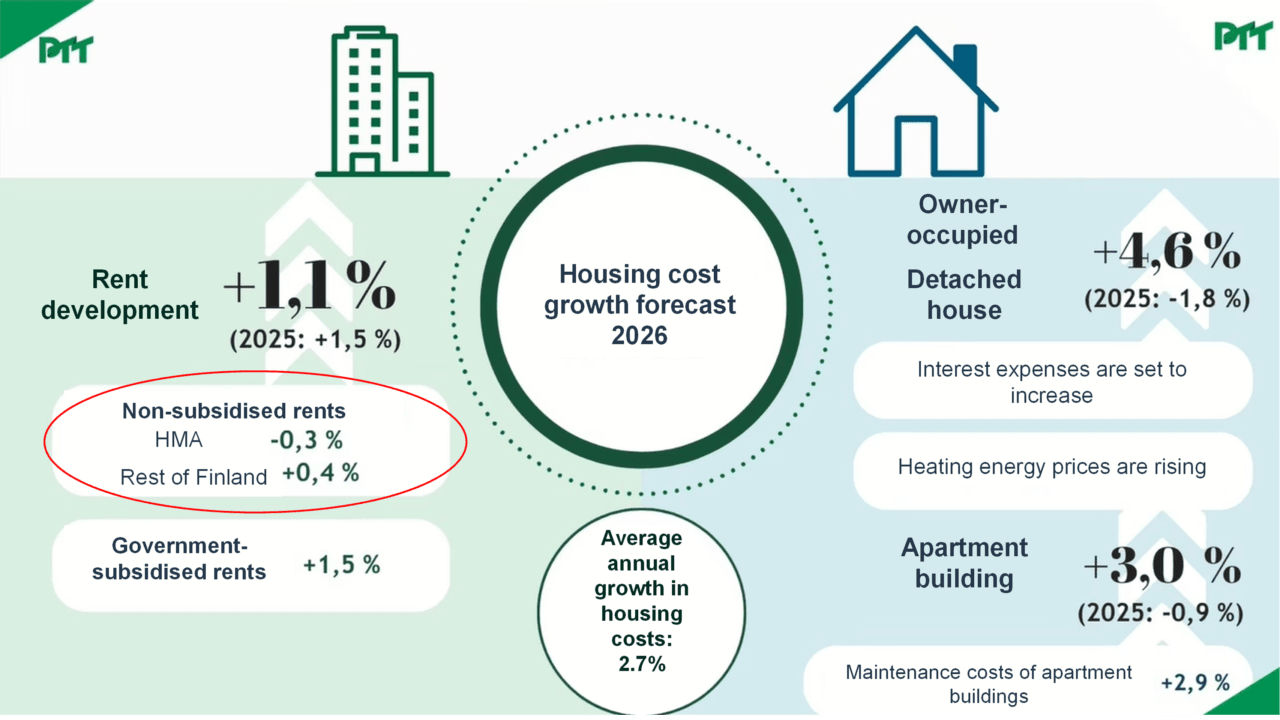
Although occupancy rates in the Helsinki metropolitan area have improved, the emerging turnaround is still in its early stages. The market also remains soft outside the Helsinki metropolitan area: according to SATO, the number of vacant apartments has continued to increase in its key markets of Tampere and Turku. The current market situation is also reflected in this year’s rent forecasts. According to PTT’s forecast published on 18 August, the large supply of non-subsidised rental apartments in the Helsinki metropolitan area will keep rent growth in negative territory this year, at -0.3%, while rents elsewhere in Finland are expected to rise moderately by around 0.4%.
Large cities outside the Helsinki metropolitan area have maintained clearly higher occupancy rates than the Helsinki metropolitan area throughout this decade. According to KTI, the average occupancy rate in large cities outside the Helsinki metropolitan area was 93.9% at the end of Q2 2026, compared with 93.5% in the Helsinki metropolitan area. The gap was this narrow in Q1 2021. The narrowing gap reflects the recent improvement in occupancy rates in the Helsinki metropolitan area. Short-term rent trends do not necessarily indicate the direction in which the market is heading..
We expect the current level of vacancy to be temporary, as exceptionally few new apartments are coming onto the market. Building permits and housing starts are close to their lowest levels on record. There are currently no signs of a rapid recovery in construction or a slowdown in migration to the major growth centres. Vacancy is therefore expected to gradually decline as the number of new apartments being completed continues to fall. Forecasts by real estate consultancies for occupancy rates in the Helsinki metropolitan area over the coming years point to a similar development. One example of the different scenarios is presented in a Finnish-language article by Helsingin Sanomat: Vuokra-asuntojen ylitarjonta pääkaupunkiseudulla on alkanut hellittää | HS.fi
The forecast presented in the article is one example of how occupancy rates in the Helsinki metropolitan area are expected to develop over the coming years under different scenarios. Even under the most pessimistic scenario, occupancy rates develop quite favourably from a professional investor’s perspective as time does its work.
The population forecast brings a smile to the face
Helsinki’s population stood at 694,392 at the end of 2025. According to the forecast and the city’s estimate, the 700,000 mark was exceeded in August 2026. With a few exceptional years, Helsinki’s population has grown by an average of around 5,500 people per year throughout the 2000s. According to the latest population forecast, growth is expected to be significantly faster in the coming years, at around 8,000–9,000 people per year. Growth is concentrated among the working-age population, which in turn supports demand for non-subsidised rental housing.
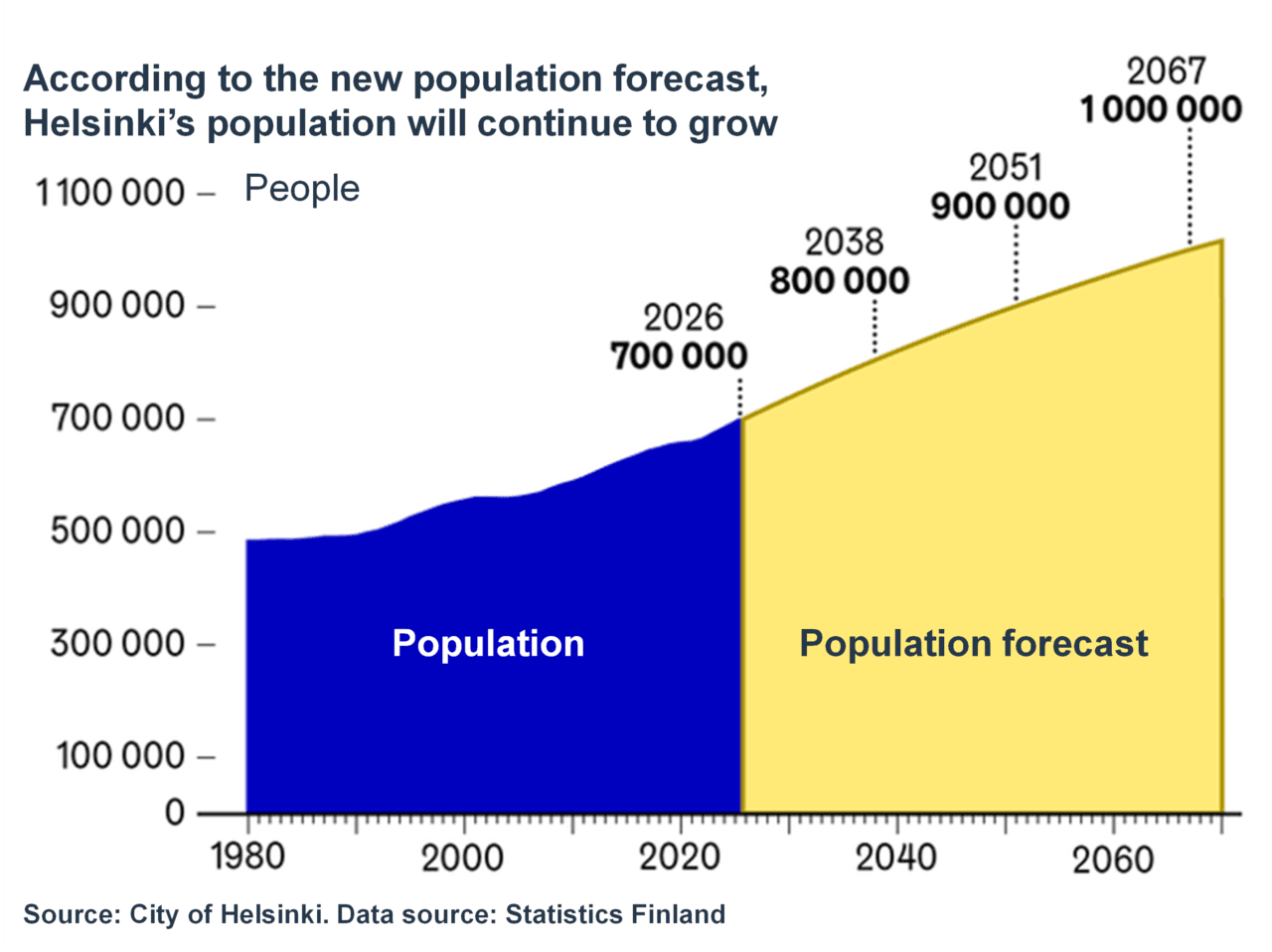
International migration is expected to become the main driver of Helsinki’s population growth, as anticipated. Net migration from abroad is projected to be around 5,000 people per year. By contrast, net domestic migration is expected to gradually decline to around 1,800 people by 2040. For comparison, Helsinki recorded net migration of around 3,200 people from abroad in 2025. Domestic net migration, meanwhile, has been mostly positive over the past ten years, averaging around 2,000 people per year.
The population forecast for early 2026 is affected by a correction to population register data for Estonian citizens, which temporarily reduces the recorded net migration*. The impact of the correction is particularly visible in the municipalities of the Helsinki metropolitan area, meaning that 2026 immigration statistics should be interpreted with greater caution than usual. The overall picture is nevertheless clear: migration to Helsinki from abroad has increased in recent years and is expected to remain strong in the future.
“From an investor’s perspective, the Helsinki metropolitan area’s rental market has been criticised, partly for good reason. According to Statistics Finland, rents in the Helsinki metropolitan area fell by 0.3% in Q2. Professional investors have so far been unable to fully implement index-linked rent increases, with increases largely being applied on a case-by-case basis. However, rental statistics look in the rear-view mirror and do not necessarily reflect where the market is heading,” concludes Takkavuori.
“From a professional investor’s perspective, occupancy rates in the Helsinki metropolitan area have developed favourably, and forecasts for occupancy rates of non-subsidised rental housing also point to further improvement in the coming years. The outlook would change significantly if housing starts were to rise sharply or migration to the major growth centres were to dry up. Current building permits and housing starts already provide a fairly good indication of how much new housing supply will come onto the market in the coming years. The biggest question mark for the positive outlook for occupancy rates in the Helsinki metropolitan area is therefore the pace of population growth. If current population forecasts come true, the picture looks quite clear from a professional investor’s perspective. The dogs may be barking in the Helsinki metropolitan area’s rental market, but the caravan keeps moving”, Takkavuori continues.
Sources: Varke, PTT, KTI and the city of Helsinki Helsingin
*More information on the correction of the Estonian population register data can be found here in Finnish: Maastamuutot Viroon laskivat Suomen väkilukua helmikuussa 2026 – kyse on tietojen korjauksesta väestötietojärjestelmässä | Tilastokeskus)
Additional information