
Share
The Nordics are often viewed as a single rental housing market, yet the structure and operating models of these markets differ significantly from one country to another. At the same time, all Nordic countries share key fundamentals, including urbanisation, housing demand concentrated in major growth centres, and the important role of rental housing. Due to historical, structural, and regulatory differences, rental market trends, challenges, and investment environments vary considerably across Sweden, Denmark, and Finland.
Sweden: Demand Tailwinds Keep Housing Queues Growing
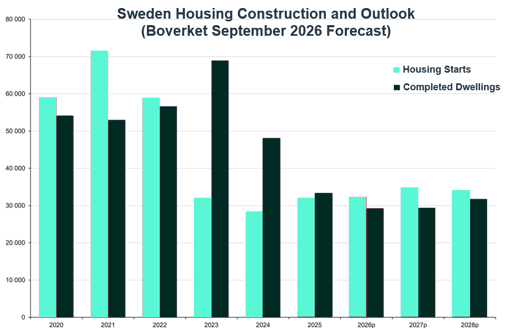
Sweden’s rental housing market is characterised by extensive rent regulation. Rents are determined largely under the bruksvärdessystem (utility value system), whereby rent levels are based on a dwelling’s use value. The system has helped maintain affordable rent levels and stable rental growth, but it has also been criticised for weakening incentives to develop new rental housing, particularly in high-growth areas. As a result, the imbalance between housing demand and supply has widened in regions experiencing strong population growth.
According to Boverket’s autumn 2026 forecast, just over 32,000 dwellings are expected to be started in Sweden this year, with housing construction projected to recover only gradually over the coming years. This remains far below Boverket’s estimated annual housing need of 52,300 dwellings. With population growth continuing to concentrate in the largest urban regions, weak housing construction is expected to sustain housing shortages, reinforcing Sweden’s reputation as one of the most structurally supply-constrained housing markets in the Nordics.
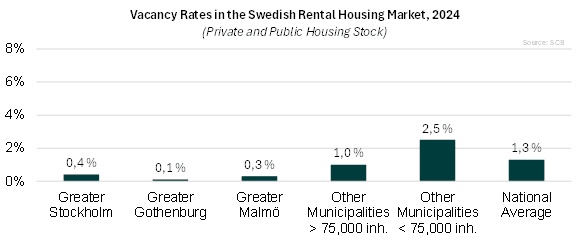
Thanks to rent regulation, rents in hyresrätt (rental tenure) housing remain attractive to tenants, but housing availability in the major growth centres is limited. The housing shortage is most acute in the Stockholm, Gothenburg and Malmö regions, where the vacancy rate for rental housing averaged only around 0.3% in 2024. Vacancy rates are also low at the national level, standing at just 1.3%, a level that is generally considered insufficient for a well-functioning housing market. Statistics Sweden (SCB) collects vacancy rate data every three years from 2024 onwards, making the 2024 figures the most recent. Up-to-date information on market conditions is provided, e.g. by interim reports from major landlords, which indicate that occupancy rates have remained high in growth centres, although regional differences have increased.
Limited housing supply remains one of the key challenges facing Sweden’s metropolitan areas. The shortage of rental housing constrains labour mobility and student migration and may increasingly act as a bottleneck to regional economic growth. As a result, the challenges facing Sweden’s housing market have become increasingly regional in nature. This is also reflected in data from Statistics Sweden.
Around 70% of vacant rental apartments are located in municipalities with fewer than 75,000 inhabitants, highlighting the growing gap between Sweden’s metropolitan and regional housing markets. During the refugee influx of the mid-2010s, many smaller municipalities were able to absorb previously vacant apartments and, in some cases, expand their housing stock. As migration patterns later shifted towards larger cities and labour markets, several of these municipalities returned to stagnant population growth and rising vacancy rates.
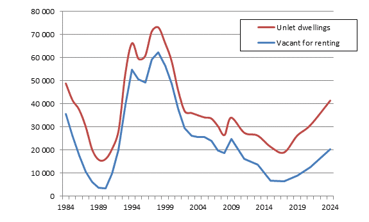
The Riksbank has also warned that slower population growth could further increase housing oversupply in smaller municipalities. With urbanisation expected to continue, the gap between Sweden’s major growth centres and some regional housing markets may widen further in the coming years. This suggests that while housing shortages remain a defining feature of Sweden’s major growth centres, supply conditions vary considerably across the country. Despite this growing divide, the impact on rental growth has remained limited.
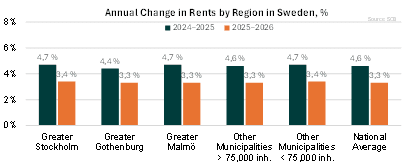
Rents in Sweden are largely determined through collective negotiations between landlords and tenant associations, which has contributed to relatively stable rent growth and modest regional differences. Between 2025 and 2026, rents increased by an average of 3.3%, compared with 4.6% in the previous year. Rent growth was broadly consistent across the country. Over the longer term, Sweden’s rental market has been exceptionally stable, with nominal rents rising continuously and without any years of decline throughout the entire period from 1969 to 2025.
Finland: Rain Clouds Remain, but Clearer Skies Lie Ahead
Finland’s rental housing market was liberalised in the aftermath of the recession of the 1990s, and rents are now largely determined by market forces. Unlike in Sweden, rental growth in Finland reflects economic conditions and changes in housing demand and supply more directly. The market-based rental sector is complemented by a state-subsidised rental housing sector, where rents are set according to the cost-price principle and housing is regulated by VARKE (formerly ARA). Rents in these properties are typically lower than in the private rental market, and tenant selection is subject to income and asset criteria.
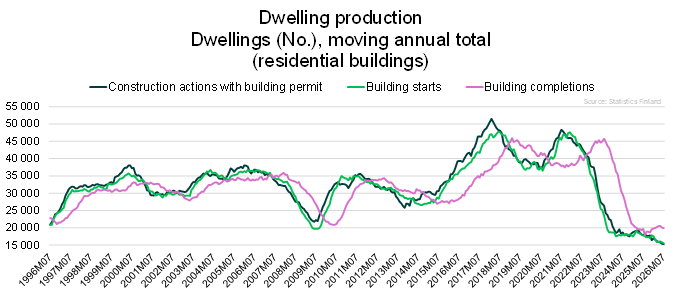
While finding a rental apartment in Sweden’s major cities may require years of waiting, tenants in Finland can often secure suitable housing within days or even hours. Between 2018 and 2023, housing construction reached record-high levels, supported by favourable market conditions. As a result of this construction wave, the increase in housing supply has led to lower occupancy rates and subdued rent growth in the private rental sector. The abundant supply of housing has also affected the owner-occupied housing market, where the decline in house prices that began after the 2022 peak has become the longest on record.
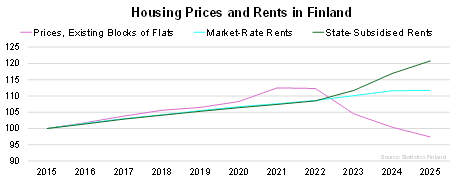
Although residential construction has fallen to historically low levels within just a few years, the market is still digesting the excess supply created during the zero-interest-rate construction boom. The rebalancing process has been further slowed by weak economic growth and housing benefit cuts implemented in 2024 and 2025. Compared with Sweden, Finland spends considerably more on housing benefits, both in absolute terms and relative to GDP, making housing support an important driver of the rental market.
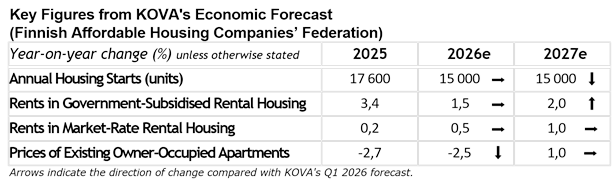
At the same time, the gap between market-rate and subsidised rents has narrowed for several consecutive years, as market rent growth has lagged behind cost-based rent increases in government-subsidised housing. This has improved the competitiveness of private rental housing. There are also signs that the rental market is gradually rebalancing. Occupancy rates among professional landlords in the Helsinki metropolitan area fell to below 90% at their lowest point but had recovered to 95,3 % by the 26Q3 according to KTI. Also, occupancy rates in the six largest cities outside the HMA averaged 96.4% at the end of 26Q3. The improvement in occupancy rates has further strengthened confidence in the outlook for the Finnish residential rental market.
Occupancy rate forecasts for the HMA remain favourable, as discussed in our 26Q2 market review. Occupancy rates have been on an upward trend and are expected to continue improving, although seasonal fluctuations may cause short-term volatility. Housing construction has remained well below the long-term annual requirement of approximately 30,000 to 35,000 dwellings, and the latest forecasts suggest that residential development will remain weak in the coming years. 2027 is set to become the fifth consecutive year in which housing starts remain below 20,000. At the same time, population growth continues to be strong in the Helsinki metropolitan area as well as in the Tampere and Turku regions.
Finland’s rental housing market benefits from strong long-term demand driven by urbanisation, market-based rent setting, and a stable and predictable operating environment. Unlike Sweden, the key challenge is not a structural housing shortage, but rather the substantial increase in supply that emerged in growth centres during the low-interest-rate years. The gradual rebalancing of the market and improving occupancy rates have strengthened investor confidence in the residential sector. This has been reflected in a recovery of investment activity and growing interest from international investors in the Finnish residential market.
Denmark: Tailwinds Today, Clear Skies Ahead
Denmark’s housing policy, much like that of Finland and Sweden, has aimed to ensure a diverse housing supply for different population groups. While the non-profit rental housing sector continues to play an important role, housing policy has gradually shifted towards a more market-oriented approach over recent decades. The regulation of the rental market is multi-layered, with rent-setting mechanisms varying according to a property’s age and characteristics. In particular, rents in dwellings completed after 1991 are largely determined by market conditions, resulting in significantly higher rents for new-build properties than in older rental housing.
From an investor’s perspective, one of the key strengths of Denmark’s rental market is its exceptionally low vacancy rate. The vacancy rate for privately owned rental housing stood at a record-low 1.9% in Q1 2026. Although vacancy increased by 0.2 percentage points to 2.1% in Q3 2026, market conditions remain tight. By historical standards, vacancy levels in Denmark’s private rental sector remain very low.
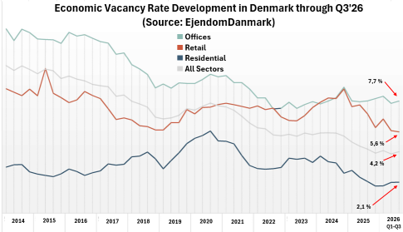
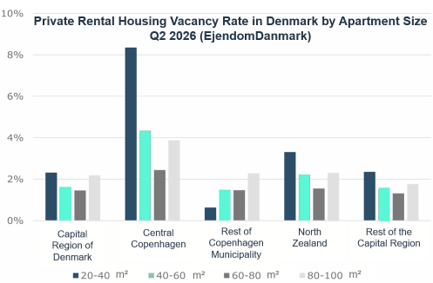
The slight increase in vacancy rates primarily reflects developments in Denmark’s capital region. While the vacancy rate in the Greater Copenhagen area remained low at 2.2% in Q3 2026, differences between submarkets have widened. In particular, the share of vacant apartments in Central Copenhagen rose to 4.6%, the highest level within the capital region. Over the past year, vacancy rates increased particularly among smaller apartments (20-40 sqm) in Central Copenhagen.
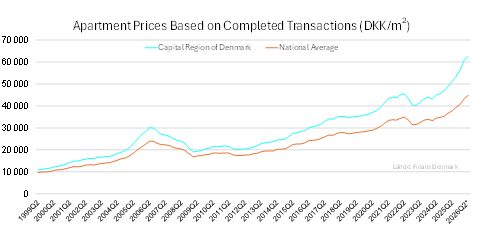
Although occupancy rates in Central Copenhagen have softened recently, the overall outlook for Denmark’s rental housing market remains strong. Housing supply is expected to remain limited in the coming years. One of the key drivers is the sharp slowdown in residential construction in recent years. Higher interest rates, rising construction costs and weaker project economics have significantly reduced the number of new developments being initiated. Building permit volumes have fallen to historically low levels, suggesting that housing supply is likely to remain constrained over the coming years. Strong growth in owner-occupied housing prices is also supporting demand for rental housing. In Copenhagen in particular, house prices have risen considerably faster than household incomes, reducing housing affordability and increasing the attractiveness of rental accommodation. Housing prices in the Danish capital region have outperformed the rest of the country, widening the gap to the national average and reflecting the region’s favourable market fundamentals.
Urbanisation continues in Denmark, with population growth concentrated in the major cities and average household sizes declining, both of which support housing demand. International migration also plays an important role in the Greater Copenhagen rental market, as many foreign workers rent rather than buy homes due to the high cost of homeownership and barriers to entering the owner-occupied market.
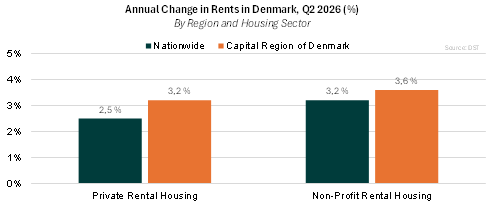
Strong demand, combined with limited housing supply, has kept occupancy rates high and maintained a landlord-favourable market balance. This has also been reflected in rental growth, with rents rising steadily by around 2-3% per year in recent years. In Q2 2026, rents for private rental housing in the Copenhagen metropolitan area increased by 3.2% year-on-year. Supported by high occupancy rates and constrained supply, the outlook for rental growth remains positive.